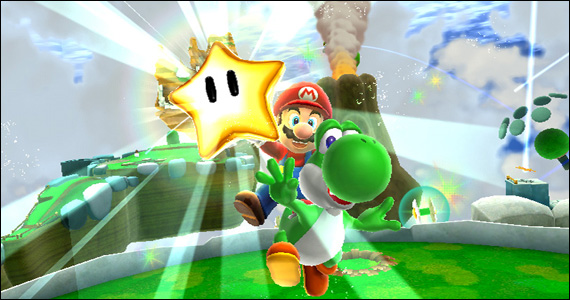
Anyone who really believes that Japanese game design has a declining role against the success of Western game development needs to dunk their head in a pool of water – specifically the floating pools of water suspended in the air, rotating between connections with other pools as Mario attempts to swim toward the next checkpoint. Somewhere along the way players will also be hitting switches that alter the directional force of gravity while trying to grab a star, and the significance of a rare second mainline Super Mario title during a single hardware cycle becomes as clear as those small floating cubes of water.
Within Mario’s Galaxy, anything can and will happen. And what’s truly surprising is the depth of logic at play while navigating the sea of sudden possibilities that shows the complete lack of inhibition proving one of Nintendo EAD’s greatest design strengths.
For some a building is a place where action takes place around or within. In Super Mario Galaxy 2, bricks break free of structures to create pathways toward star portals, launching players through the roof and into the sea of stars overhead.
Short on filler and stuffed plump with that type of energy, the results are often extraordinary.
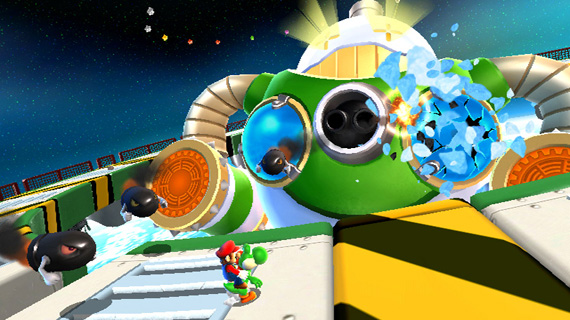
Super Mario Galaxy 2 is as light on narrative direction as ever – Bowser shows up long enough to steal stars and announce his new empire before grabbing Princess Peach and leaving Mario at square one. The cosmic dance between these two famous adversaries once again serves a simple role, laying out the grid and delivery system for level design that explodes with imagination – discoveries and treats that make me smile like a damn fool even after all these years.
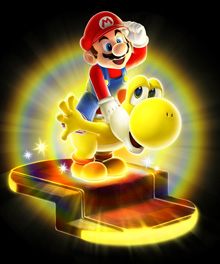
Know Your Yoshi – Besides giving Mario a chance to ride in style, Yoshi’s as handy as ever for eating down the Goomba population.
This time around there’s a few more fruits growing in the universe that let Yoshi dash across water and up steep hills, float skyward to help Mario reach new peaks, and even light the way through the hidden pathways of Boo infested spaces.
Familiar and nostalgic tricks return as Mario rides moving platforms, stomps down the Goomba population, dodges flame chains and leaps across pits that furnish the entirety of the series.
These staples are sprinkled over fresher ideas that play with gravity and distance to challenge the often straightforward approach to videogame design, creating sequences that are briefly baffling before crystallizing out of some divine liquid brilliance.
The greater share of pleasant surprises is fueled by a consistently changing camera perspective that switches players between 3D and 2.5Dish environments. The crossing design streams allows the variety of galaxies on hand to explore the depth of both approaches, often finding the best at the edges of each, from underwater tours on a turtle shell to downhill slides, and from panel flipping walkways to gravity shifting interiors.
Just as grabbing Bullet Bills with Yoshi and firing them back at objects to clear the path ahead seems like the slickest sequence yet, the game suddenly has you grabbing on to stars and playing with the gravity pull while cannons fill the screen with peril.
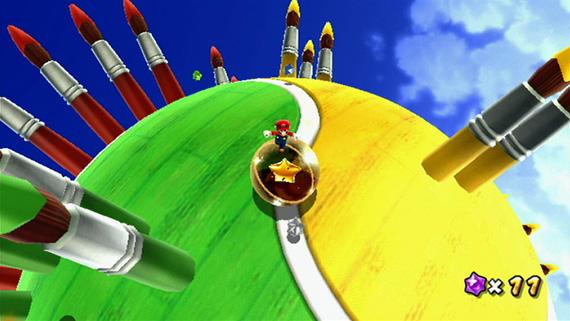
It’s not without some snags, specifically as Nintendo brings some strangely obligatory WiiMote service into play – they just can’t resist some mandatory nod to their motion controls. Rolling and balancing on a ball through a course isn’t a deal breaker, but suffering through flight missions with Fluzzard severely tests my patience.
It’s a slight detour, slight enough to be overlooked, and also slight enough for us to question why it was worth breaking up the flow of design to stick such awkward sequences in as I try to steady my arm to guide Mario and his bird to the finish line.
Occasional underwater sequences suffer some camera retardation, specifically when diving into a small opening and trying to orient your direction – working to swim to the top of a building met with the limits of the camera as the view switched to an external shot of the structure and I was left guessing my way to the surface.

Maestro Mario – The orchestrated soundtrack running throughout Galaxy 2 reaches heights that match and at times best the action. Old favorites join new pieces to create a true space opera sensation for Mario’s adventure.
Touring through everything the universe has to offer, it’s easy to say this is the closest the 3D side of the series has come to realizing the depth and magic the 2D originals stirred within my young gamer soul.
The shear amount of secrets and side missions spread throughout the game, along with the “everything plus the kitchen sink” experience that hasn’t really been felt since Super Mario Bros. 3 aids in backing up that claim.
What really cements the deal however is the way in which even with the still nagging hiccups previously mentioned, this is the first 3D Mario title wherein the fight is less about repositioning the camera and more about the skill necessary in overcoming the challenges presented by the levels.
So many lost lives left me cursing my own slow fingers for missing jumps or being struck by fire, putting me closer than ever to the days when the stage design was the challenge, not the technical limitations inherent in the awkward evolution of the code.
This really comes together in the castle designs, which run the gambit on the ideas of every galaxy, and enthusiastically use the perspective switching camera to have players running upside walls while fire arches downward, and spinning columns change the direction of action with every leap.
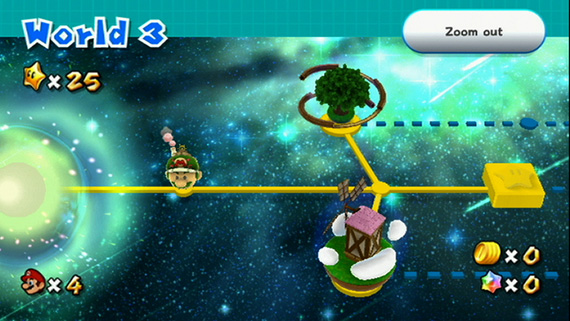
What slows my tongue for claiming that Galaxy 2 matches the place in my heart so lovingly occupied by Super Mario World is the same element that makes this newest entry so infinity accessible. While players cruise the universe on Starship Mario, the overworld map stretches out with a minimalist aesthetic that keeps stage access and item locations clearly marked.
The celestial design that makes anything possible also defies the ability to unify the overarching layout, which sacrifices the subtle narrative joys of a game like Super Mario World – watching as the island expands to reveal more secrets. Within Galaxy 2 the universe has a clearly marked highway connecting players through portals toward the goal of Bowser’s fortress at all times.
This filters down into the level design, where the power-ups required to overcome challenges only exist within the stages necessitating their use. This creates a game where the way ahead is consistently clear, removing a certain element of mystery that made the earlier entries in the series the type of titles the old school faithful continue to play and discuss today.
If you remember the way we could take Yoshi or a cape into any stage we wanted, the way we could use a Blue Yoshi to explore every bit of empty space to find secrets and bonuses – the way it felt like we could almost break the rules of every level via the ability to take those powers anywhere – then perhaps you’ll know what I mean. As polished and impressive as the series has become, we’re a long way from the company that stuck a Goomba in a giant windup boot simply because it could.
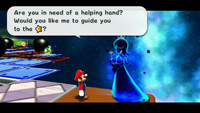
A Helping Hand – Anytime players are stuck; ie-when you start dying a lot, The Cosmic Guide will appear in the area to offer a hand – running players through the hurdles of a stage for as long as they want.
Small wonders of that nature have been left behind in the pursuit of a more accessible and logical experience, attempting to bring those type of discoveries to every stage, but losing a bit in the translation and the reality of that confinement, despite the inherent fun still brimming within.
The Cosmic Guide would seem to speak to that growing concern of accessibility, appearing to offer assistance as players suffer repeated failures – playing through however much of the stage as players wish. It’s a feature I instantly considered lost on me until finally finding a use I hadn’t expected near the end of the game.
The potentially embarrassing moment involved a downhill slide stage where watching the Cosmic Guide reminded me that I needed to spin to extend the distance of a jump – but if you tell anyone I used it even that once I’ll call you a liar.
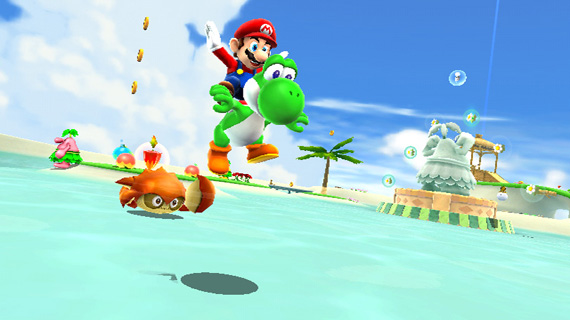
The other issue of containment is entirely about the role of Yoshi – keep in mind that there is never a bad word to really be said about the appearance of Yoshi. With that said however, his return suffers the same limitations as the various power-ups scattered throughout the game. Players will only encounter Yoshi in areas where his presence is required.
Yoshi appears within ghost houses that require his light ability to show the invisible floors, or where madly angled panels require his new chilli pepper powered dash ability. Just as with Rock Mario and Cloud Mario, Yoshi’s company is never let as loose as it was in the days when our favorite dinosaur would travel everywhere to find new and unexpected purpose – short of castles and ghost houses of course. Oddly enough Yoshi has lost his fear of those environments with this trip into space.

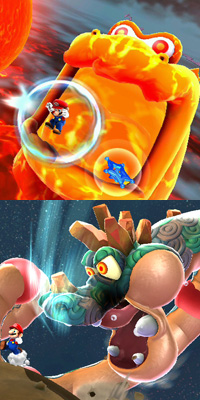
Having already appeared in the earlier released New Super Mario Bros. Wii, the Koopa Kids sit out the action of Super Mario Galaxy 2 while Bowser Jr. once again tries to make his old man proud by crushing Mario’s rescue attempts. The freedom to experiment brings to life a variety of boss battles with new creatures, many of which still subscribe to the series staple of three hits leading to victory.
The planetary scenario greatly effects the way this familiar dance plays out however, leaving players to dodge a giant worm as it drills through the planet Mario is standing on to temporally expose weak points, drill through a planet to strike at the soft underbelly of machinery, and hop on Yoshi to dodge a barrage of Bullet Bills before firing one back to hit the critical points of a giant robot.
The target is always made easily visible by color, leaving the mix of environmental settings and enemy attack patterns to create earnestly fulfilling encounters.
Striking a gigantic Bowser by jumping on to comets and slamming them in his direction finds a clever mix of old and new that permeates nearly every grander battle.
Super Mario Galaxy 2 offers an immediately accessible experience that let’s players get to the business of collecting star bits and chasing down Bowser without any nagging explanatory narrative, relying on the simplistic charm of the industry’s longest running series to direct players of all backgrounds toward the goal.
The result is a game that brings together a series of brilliantly designed levels that set the bar in terms of imaginative possibilities and tactile realizations, leaving it difficult to complain about the new aesthetic that simplifies the larger view by stitching it altogether with minimalist detail. Super Mario Galaxy 2 manages to deliver so many cosmic pockets of wonder in the process, seemingly perfecting the experiment started on the N64. When the brain surrenders to the natural rhythm these levels often stir within the fingers, tripping the rift through this newest galaxy is too intoxicating to resist.
Super Mario Galaxy 2
Developer – Nintendo EAD
Publisher – Nintendo
System – Nintendo Wii
Release Date – May 23, 2010
*A copy of this title was provided by the publisher for review
“Rolling and balancing on a ball through a course isn’t a deal breaker” This… this is the deal breaker for me. I quit playing the original SMG when I was tired of trying to beat the Super Monkey Ballz level. I also don’t feel all that comfortable with jumping on Goombas… which again I might have to blame on my left handedness instead of the actual game mechanics itself. Actually I blame the Wiimote/Nunchuck and wish these games had options for Classic Controls. I think that might actually be the biggest reason I don’t play my Wii very much.
Comment by Ujn Hunter — June 2, 2010 @ 1:22 pm
While I can’t completely understand the left handed issue, being right handed, that bit of motion control is really frustrating – particularly because I want to say it can be skipped, but at some point I had to deal with Fluzzard when I couldn’t get the stars I needed elsewhere.
There are a few things that I do like, pointing at starbits to grab them, pointing at stars and clicking to pull myself toward them, a few little joys that a classic controller couldn’t do that they wisely stuck in.
Comment by Jamie Love — June 3, 2010 @ 9:19 am
@Ujn: Wait, if you’re left handed then what’s the problem? Use the Nunchuck on your right hand and the Wiimote on your left and problem solved, right? Or am I missing something?
I loved the original SMG and wanted a sequel the moment I finished it with Luigi. The game is fun and is a great companion piece to the original game.
Comment by EdEN — June 2, 2010 @ 2:45 pm
That’s what I do… Wiimote in left hand and Nunchuck in right hand… but I think it has to do with the whole moving around with my right thumb… I’m so used to playing like everyone else on a normal controller with my LEFT thumb. It’s pretty hard to explain to people that it doesn’t affect… it sounds like a simple solution to other people… :\
Comment by Ujn Hunter — June 2, 2010 @ 2:55 pm
So your left handed but still use a PS3 controller in a regular way? That just sounds weird and confusing for your brain hehehe. I assumed the Wiimote+Nunchuck was the best control configuration out there for left handed people since you can just switch them and… presto! It seems I was mistaken.
Comment by EdEN — June 2, 2010 @ 3:02 pm
@EdEN: Yes I use the PS3 controller like everyone else… since I was young games have always been designed based around the same standard type controller, one that makes use of your thumbs and fingers. The Wii is the first controller that makes use of your hands/arms as opposed to your fingers/thumbs (yes, you still use those too!) and this changes things because they were obviously designed for right handed people (just look at how they changed Link!).
I can try and compare like this: the Classic Controller is like a Keyboard on a computer… you have no problem pushing buttons with both hands just like you have no problem typing with fingers on both hands. However unless you’re ambidextrous I doubt you can write very well with your “off” hand or throw a baseball with it. Think of the Wiimote as handicapping me with either the choice of writing/pitching with my “off” hand or going against the game design (on games that don’t allow left/right handed choices) and forcing my brain/fingers to go against everything I’ve been doing for 24+ years of gaming.
When they designed the Wiimote/Nunchuck… they broke apart a standard controller so you could hold each half in a hand. The problem for me… is that they designed it for right handed people (which obviously they would, as most people are right handed).
Comment by Ujn Hunter — June 3, 2010 @ 10:39 am
According to Iwata the controller was designed the way it was so both right and left handed people could play since all they had to do was switch them from one hand to the other. Seems they didn’t consider some of the neurological connections that are more apparent in left handed people.
Got me thinking into one of those questions you make when you’re bored: “what would you loose, a leg or an arm?” For me, it would be my left leg. If I still had my right leg I could still drive and play drums (except for opening/closing the hi hat but than can be fixed with a second hi-hat) and play most videogames with ease. Loosing an arm would seeeeriously limit my hobby.
Now with that random thought out of the way, what are some of the Wii games you have trouble controlling?
Comment by EdEN — June 3, 2010 @ 11:57 am
I am left handed…therefore I can tell everyone that there is absolutely no difference in the way that I play the wii compared to a “righty”. The easiest way to explain it is by comparing it to a PS3 or any classic controller. The hand that moves the character (using directional buttons) is your LEFT hand. The action buttons are controlled by the RIGHT hand. So, just like a classic controller, I control motion with my left (nunchuck goes here) and action with my right (wii-mote goes here).
Comment by stephanie — June 5, 2010 @ 9:00 pm
Of course that is the way it is designed to be held… but I don’t feel comfortable holding the Wiimote in my right hand… pointing and moving my arm around is unnatural to me with my right hand. Now if Nintendo made some kind of Wiimote with an analog stick so that I could move and point with my left hand… that would be awesome!
Comment by Ujn Hunter — June 5, 2010 @ 9:45 pm
I just cant play this game being left handed… the thing is… all my life i´ve moved the character/cursor/whatever whit my left thumb and my main hand is left… so heres the problem… i hold the wiimote with my left hand… since is the only way i can, and i have to do with my right thumb (and im not that good with my right hand) what i have been doing all my life with my left thumb… is just odd… and it makes my movement slow and cluncky…
Comment by Tyrant — July 11, 2010 @ 12:29 pm
Someone who shares my problem! I was beginning to think I was the only person to suffer. :( I feel your pain.
Comment by Ujn Hunter — July 11, 2010 @ 5:55 pm
I feel like a jerk for taking my right handedness for granted :(
Comment by Jamie Love — July 11, 2010 @ 5:56 pm