That damn Michael Tucker has derailed my entire day by posting a link to that very fine read, Less Talk, More Rock. I’ve read it eight times now while consuming coffee and having a short twitter back-and-forth with @the1console about it.
At this point I’ve emerged with a few thoughts, aside from a small bout of jealously over not having written it myself.
So let’s talk about the role of words and language within videogames, because that’s what reading the post so many times got me thinking about. And before I start, I’ll stress that I don’t feel the article implies that designers should abandon language within gaming, it simply got me thinking about the way language has been treated within gaming – which to date is very poorly and owing almost entirely to the way the industry has treated language as a tool rather than an additional artistic form of expression.
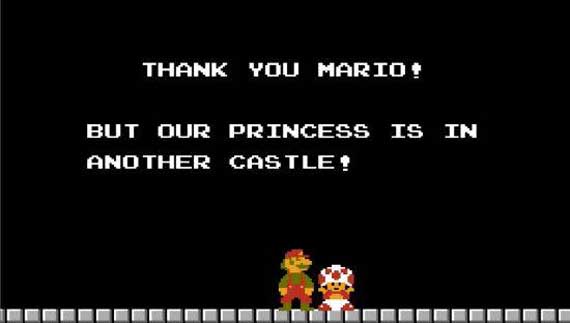
“…our Princess is in another castle!”
That’s the bit of Super Mario Bros. that relies on the written word to express something otherwise inexpressible – I mean what was an 8-bit Toadstool going to do otherwise, shrug at Mario and point to a door? Without this bit of language, the game would come across as an endless circular hell with no direction – no matter what anyone tells you, this is how the idea that there is a narrative is strengthened and enforced and without it, you’re playing an Atari game.
And as much as minimal language gives Super Mario Bros. less talk and more rock, it also represents the earliest intentions of game designers with respect to language – which is to see the role of it confined to the expression of directions and ideas that lacked an easily recognizable visual substitute capable of conveying the idea as easily – and EASILY is a big word here, because there are times where words are used simply because it is easier.
BUT, the bigger point is that language has been enslaved by the gaming industry as a tool toward this end. And for a medium that bears the burden of being the best of all our future creative endeavors, it’s a severe oversight, because that one medium to rule them all draws power for that bold statement to be true because it can draw all other forms of art and expression into itself – the audio, the video, the horizontal and the vertical and never forgetting the physical and tactile – but not at the expense of the written and the verbal, which have never been recognized as an art form by the industry proper.
Why do I claim there’s no respect?
The written word, and language, are seen as they are used within gaming, as a tool, a descriptor, and as a direct act of forcing narrative intention. If studios and publishers want “narrative”, they seek out the best of the novel set, failing from the start by trying to insert one form of the language medium as an attachment, rather than taking the grains of it and integrating that into their designs.
Once again what the hell do I mean? Well we don’t incorporate film aspirations into games by switching between the two like a light switch – okay we in fact do often do this but we know the best games find means to take filmic concepts and ideas and use those within the gaming space, not just show us movies that make us put down the controller.
And let’s face it, for the longest time language and writing were seen as things the designers did in their off hours. I don’t go around thinking I can code a game, so why the hell should you know the potential for language within it? Every other art form has specialists in game design, but when it comes to language, is anyone really engaging the specialists of that medium? If simply hiring on a novel writer to write scripts for a game without any real concept of that potential relationship between the code and the word is good enough, well then yes I guess we can say it is – but that’s a bunch of bull.
There are examples where good things have happened of course.
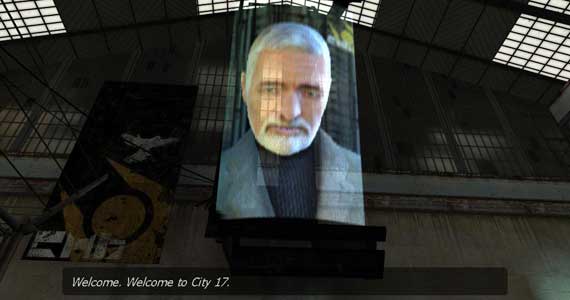
Let’s drag Half-Life 2 out to the party – a game that rid itself of filmic interference by integrating aspects of that medium into the design of the game, which also drove a very visual narrative. And the game also did something else with language – it used one form of it to enrich the world it presented.
When you’re wandering through Combine facilities and hearing Breen’s speeches on the radio and view screens, you’re absorbing an added layer of depth that paints a deeper grain about that world and the oppression of it, because we recognize the audio as propaganda. And Valve uses this in a way that doesn’t tear you out of that world but invests you into it more deeply. At the same time, this is a small success for language only, not far removed from what the radio does within a Grand Theft Auto title.
Even more examples can be found in the way an old school fan of Working Designs will tell you how the company’s localization made a game better.
Yet these are still merely added layers of narrative direction even if more subtle, and language has much more to offer.
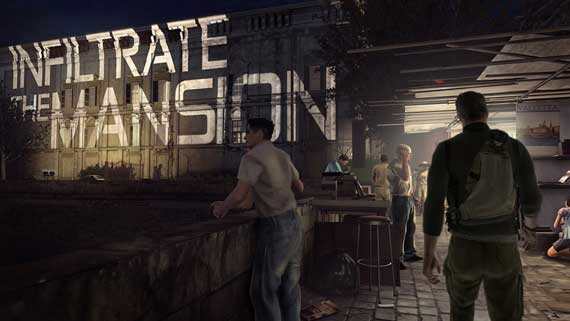
Splinter Cell Conviction got more attention from me than it deserved at E3 because of the way it was layering textual objectives over said objectives within the game. Now, obviously this is doing away with some flat mission statements and other textual garbage normally shoveled at the player prior to each stage with screens or maps. What matters to me here is that there is a potential to appreciate the physical artistry of words within the visual gaming space.
Maybe I think about the relationship between the signifier and the signified a bit too much, but when I look at a cat I think about the physical being of the animal as much as the word forever tied to it. So seeing the flash of words about Sam Fisher’s daughter mixed with images of her as he moves toward the target of his vengeance feels like a step not necessarily in the right direction, but at this point any direction has to be worth some flag waving.
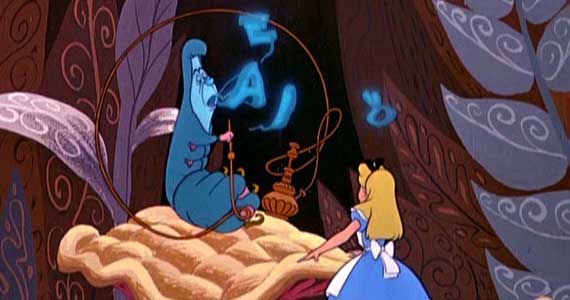
Keep in mind I get off a bit on the Caterpillar from Disney’s Alice in Wonderland, puffing words of smoke as he speaks them – or when the narrator of Winnie the Pooh physically tilts the book so Tigger can slide down a paragraph to safety. What do you want, I’m a English major at heart.
As clumsily as it comes across, a game like Scribblenauts offers a certain playful respect for the way words create objects and spaces, for the power of the connection between the signifier and the signified.
Words have a playful space that we don’t enjoy enough, the way the screen flashes BAM! when Batman hits a villain, or more recently with the epic trailer epicness of Scott Pilgrim vs the World.
Simply appreciating the play of language both verbally and visually in relationship to game design is at least a good place to start, since as it stands it really does seem like we don’t enjoy one of the greatest joys available to us. I’m not advocating that we directly begin work on Italo Calvino: The Videogame – I’m just a guy raging over the lack of dialogue about the role of language in all sorts of directions.
At present all I’m asking is that you consider that language has been a second class citizen within the industry – except for the excellent gains in its manipulative abilities made by PR peeps – and that’s a barrier causing language to come across as such a disruptive element of game design. Let’s be clear, I don’t have it all figured out, but I damn well recognize that there’s a problem we should talk about more.
This piece made me think a lot about the distinction in the types of gamer as well. The target audience I guess, because I really enjoy a good storyline in a game (coming from both and English and Film background), but I know a lot of people who kind of play games to escape the literal world. They don’t want to be that involved in the experience, they really just want to shoot/blow things up. Which I’m sure is kind of an unfortunate factor in the realm of game design as well when new stories are discussed.
I also agree a lot with the part about adding cinematic elements to the gameplay, because most of the games I’ve encountered that do include a heavy literary element tend to do it more by way of lengthy cut scenes that do more interrupting then helping. Like for example “Trauma Center: Second Opinion” on the Wii. For every 30 second operation there is something like 5 minutes of dialogue to click through, and as interested as I am in the story it can get so tedious that even I end up skipping through most of it just so I can get back to playing the game.
I think this whole idea in general though is why I’m so in love with the Professor Layton series for the DS though, because the story is really compelling. It’s really clever and well thought out and the game has a really nice balance of text, gameplay and animated spoken dialogue. It’s like reading a good book, watching a good movie and playing an awesome puzzle game all rolled into one.
I know this is a hugely different genre than most of the big name console games, especially because the nature of solving a mystery relies so much on conversation. But the reason literary element in the game is so successful is because of the way it adds to the gameplay without feeling like it’s interrupting. The story is a seamless part of the experience, and without that element I think I would go as far as to say the game just wouldn’t work. Which goes back to the main problem you brought up like the Super Mario Bros. example, because up until the need for that one line the game pretty much does work without it.
Just some random thoughts, and for the record I don’t think ranting words about words is useless. lol. You bring up a lot of great points. :)
Comment by Camille — March 25, 2010 @ 11:37 pm
Thanks Camille! To be earnest, I always hesitate after writing something, unsure of whether or not it’s going to make any sense, so your thoughts definitely make me glad I pressed the publish button :D
Comment by Jamie Love — March 26, 2010 @ 10:01 am
Word have and always will be the ideal channel by which ideas and sentiments shall (or rather, should) be expressed. One word can completely change the feeling and intent of a sentence and can turn a great scene into something out of 1st grade community college drama-school in a second.
Still, writing, pacing and storytelling have never been appreciated in the gaming industry and I don’t see that changing in the short term. Maybe next gen will include “better-storytelling” as a bullet point?
Comment by EdEN — March 26, 2010 @ 1:01 pm
Damn you Eden! Now I’m going to be looking at the back of Halo 15 for “Improved narrative fidelity!”
Comment by Jamie Love — March 26, 2010 @ 1:31 pm
Isn’t it: I’m AN English major at heart? Good piece though
Comment by Massive git — April 6, 2010 @ 10:21 am
I didn’t say I was a good one!
Comment by Jamie Love — April 6, 2010 @ 10:26 am
IS GAMES ART?!??!?!
DURRRR
Comment by jimmy — April 11, 2010 @ 4:03 pm
I think my favorite commentary on the video games industry is actually one that first applied to the film industry, and it points out the issue of writers. Film writers have stopped reading books as their main source of inspiration, film writers have started watching films and taking their cues from there. It’s a difficult situation where you have a potential gray zone of no improvement.
I think video game writers have moved about with influences, but we’re doomed if video game writers start looking at video games for their narrative inspiration. I’ve grown up with people who want to write the next Final Fantasy, and when quizzed the only things they bring to the table are bigger enemies, more quests, more convoluted storylines.
Not really sure where I’m going with this, and I’m fairly tired, so yeah. Also, Jimmy, shut up.
Comment by James — April 11, 2010 @ 9:19 pm
Your argument has some merit, but one could also argue that sound design, game mechanic design, and other more subtle aspects of game design get just as much if not more undeserved lack of consideration.
In short, there are a lot more second class citizens in games than the quality of writing.
That being said, there is a place and context for each of these to flourish, and equal representation among them across games in general is neither important nor beneficial to the pursuit of making or consuming great games.
You can have a wonderful game with mostly words, and a wonderful game without any words. Seems to me there are plenty of games to enjoy in both categories.
Comment by ara shirinian — April 13, 2010 @ 7:30 pm
I’d be interested to hear what the author of this article thinks of BioWare RPGs and how they utilise language.
Comment by Cat — August 9, 2011 @ 7:20 pm
The author would have to concede that he’s just not familiar enough with Bioware’s titles to offer a legitimate opinion unfortunately. Playing through the Mass Effects is still a giant mark on my to-do list.
Comment by Jamie Love — August 10, 2011 @ 12:51 pm